
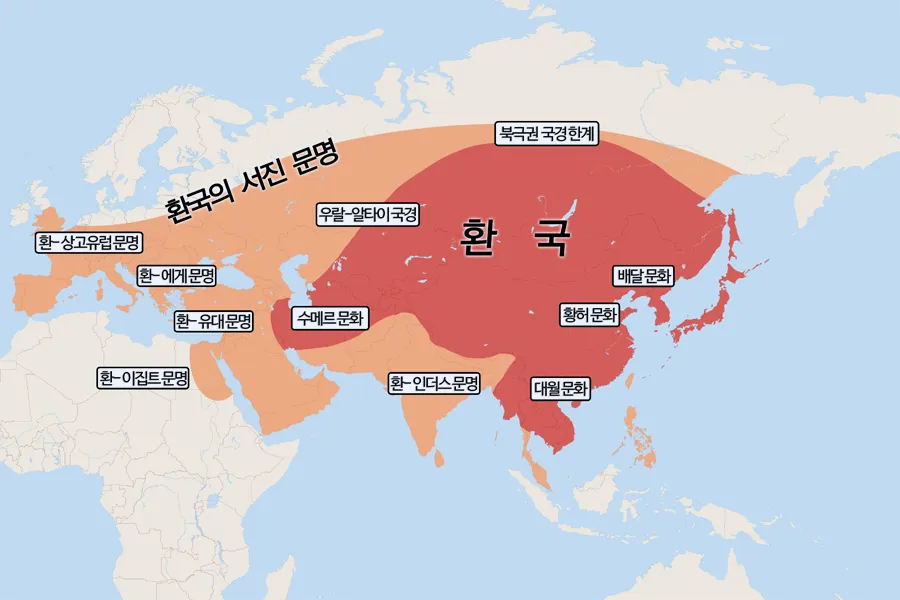
Image: Claimed territory of the Hwan Empire. Credit: Public domain.
Eyebrows were raised to the breaking point during a December 12 presidential briefing by the Northeast Asian History Foundation 동북아역사재단, a government-funded think tank supervised by the Ministry of Education 교육부. During the briefing by the foundation’s chairwoman Park Ji-hyang 박지향 이사장, president Lee Jae-myung 이재명 대통령 suggested that the NAHF was being too dismissive of the Hwandangogi 환단고기, an infamous pseudohistorical forgery.
The Hwandangogi was published in 1979 by Lee Yu-rip 이유립, who claimed that the book was originally published in 1911 by a historian named Gye Yeon-su 계연수 - whose actual existence is unclear. The book claims that ancient Korea, called the Hwan Empire 환국, extended west to east from the Middle East to Japan, and north to south from Siberia to Vietnam, and influenced civilizations in Western Europe and the Americas. The Hwan Empire allegedly accomplished during its reign from around 67000 B.C.E. to 3900 B.C.E., pre-dating Gojoseon 고조선, the oldest known civilization in the Korean Peninsula.
Ridiculous as it may seem on its face, Hwandangogi has been enormously popular among Koreans who like to imagine themselves as the descendants of a massive, ancient empire whose true history was erased by colonial rulers. After Lee’s suggestion drew criticism, presidential spokesman Kim Nam-jun 김남준 대변인 said the president’s remark did not mean he believed in or wanted the NAHF to study the Hwandangogi’s claims.